

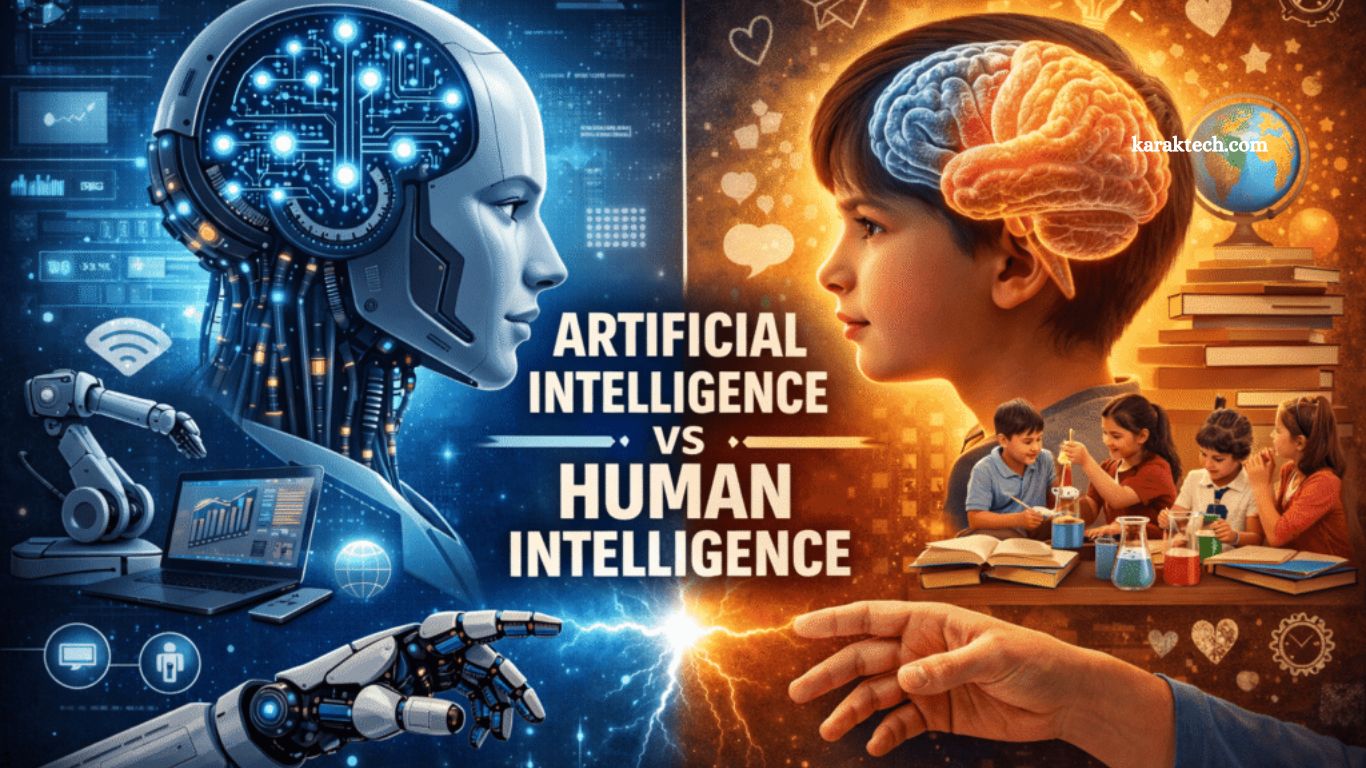
Artificial Intelligence continues reshaping industries, workplaces, and daily experiences. Rapid advancements have sparked an important discussion: AI vs Human Intelligence. Many people wonder whether machines can replace human thinking or simply enhance human capabilities.
Understanding differences between artificial intelligence and human intelligence helps individuals, businesses, and educators prepare for a technology-driven future. This article explores strengths, limitations, and practical applications of both forms of intelligence.
Read More: Best AI Websites That Make Your Work Easier
What Is Artificial Intelligence?
Artificial Intelligence refers to computer systems designed to perform tasks that normally require human intelligence. These tasks include pattern recognition, language processing, decision-making, data analysis, and problem-solving.
AI systems learn from large datasets using algorithms and models. Unlike humans, AI processes vast amounts of information within seconds and delivers consistent outputs based on programmed objectives.
Common examples include:
- Virtual assistants
- Recommendation systems
- Autonomous vehicles
- Medical diagnostic tools
- Fraud detection systems
What Is Human Intelligence?
Human intelligence represents the ability to think, reason, learn, adapt, create, and understand emotions. Human cognition develops through experience, education, social interaction, and personal reflection.
People possess qualities that extend beyond computational power, including:
- Emotional understanding
- Ethical judgment
- Creativity
- Intuition
- Contextual awareness
These characteristics allow humans to navigate complex social environments and make decisions involving uncertainty.
Key Differences Between AI and Human Intelligence
Learning Process
AI learns through data input, algorithms, and continuous training. Performance improves when systems receive additional relevant information.
Humans learn through observation, experience, education, and emotional engagement. Learning often involves imagination, critical thinking, and personal growth.
Speed and Efficiency
AI excels in speed. Complex calculations, pattern detection, and large-scale data analysis occur within moments. Human intelligence operates more slowly but offers deeper understanding, flexibility, and nuanced reasoning.
Creativity
Human creativity drives innovation across art, literature, science, and entrepreneurship. Original ideas often emerge from emotions, experiences, and abstract thinking.
AI generates content based on existing patterns. Although impressive results appear possible, true originality remains a uniquely human strength.
Emotional Intelligence
Machines lack genuine emotions. AI identifies emotional cues through data analysis but cannot experience empathy or compassion.
Humans build relationships, interpret social signals, and provide emotional support through authentic understanding.
Decision-Making
AI decisions depend on available data and predefined objectives. Accuracy increases when datasets remain comprehensive and unbiased.
Human decisions incorporate ethics, cultural values, intuition, and situational awareness. Such factors become essential during complex or sensitive circumstances.
Advantages of Artificial Intelligence
Artificial Intelligence offers numerous benefits across multiple sectors.
Increased Productivity
AI automates repetitive tasks, allowing organizations to allocate human talent toward strategic responsibilities.
Improved Accuracy
Properly trained systems reduce human error during data processing and analysis.
Continuous Operation
Machines function around the clock without fatigue, enhancing operational efficiency.
Data-Driven Insights
Advanced analytics reveal trends and opportunities hidden within massive datasets.
Advantages of Human Intelligence
Human intelligence remains indispensable despite technological progress.
Adaptability
People adjust quickly when facing unfamiliar situations requiring creative solutions.
Ethical Reasoning
Humans evaluate consequences beyond numerical outcomes, considering fairness and societal impact.
Innovation
Groundbreaking discoveries frequently arise through imagination, curiosity, and experimentation.
Relationship Building
Trust, collaboration, leadership, and communication depend heavily on emotional intelligence.
Can AI Replace Human Intelligence?
Complete replacement appears unlikely. AI performs exceptionally well within specialized domains involving structured data and predictable objectives. Human intelligence thrives in environments requiring empathy, moral judgment, creativity, and adaptability.
Future workplaces will likely emphasize collaboration rather than competition between humans and machines. AI may handle routine processes while humans focus on strategic thinking, innovation, and interpersonal responsibilities.
AI and Humans Working Together
Successful organizations increasingly adopt hybrid approaches combining technological efficiency with human expertise.
Examples include:
- Doctors using AI-assisted diagnostics
- Teachers leveraging adaptive learning platforms
- Financial analysts utilizing predictive models
- Customer service teams supported by intelligent chat systems
Such partnerships improve outcomes while preserving human oversight.
Challenges and Ethical Considerations
Growing reliance on AI introduces important concerns.
Key issues include:
- Data privacy protection
- Algorithmic bias
- Workforce transformation
- Accountability during automated decisions
- Responsible technology development
Addressing these challenges requires collaboration among policymakers, technology leaders, researchers, and communities.
Future Outlook
Artificial Intelligence will continue evolving rapidly. Human intelligence, however, remains central to guiding ethical implementation and meaningful innovation.
Rather than asking whether AI will surpass humanity, society may benefit more from exploring how both forms of intelligence can complement each other.
Balanced integration offers opportunities for economic growth, improved healthcare, enhanced education, and scientific advancement.
Frequently Asked Questions
What is the main difference between AI and human intelligence?
AI relies on data and algorithms, while human intelligence involves emotions, creativity, and critical thinking.
Can AI completely replace humans?
No. AI can automate tasks, but human judgment and emotional understanding remain essential.
Is AI more intelligent than humans?
AI outperforms humans in speed and data processing but lacks human creativity and empathy.
What are common uses of AI today?
AI supports healthcare, customer service, finance, education, and recommendation systems.
Why is human intelligence important?
Human intelligence enables ethical decisions, innovation, communication, and adaptability.
Will AI and humans work together in the future?
Yes. Most experts expect AI to enhance human capabilities rather than replace them completely.
Conclusion
The debate surrounding AI vs. human intelligence reflects broader questions about technology, identity, and progress. Artificial Intelligence delivers speed, scalability, and analytical precision. Human intelligence contributes creativity, empathy, ethical reasoning, and adaptability.
