

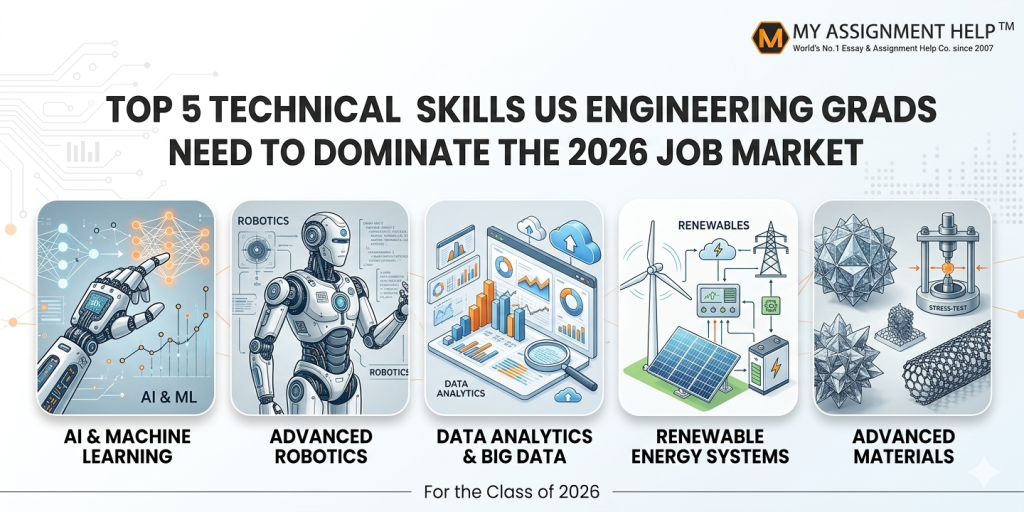
The landscape of American engineering is undergoing a seismic shift. As we navigate through 2026, the traditional boundaries between mechanical, civil, electrical, and software engineering have blurred. The integration of Generative AI, the explosion of the “Green Economy,” and the domestic resurgence of semiconductor manufacturing (fueled by the CHIPS Act) have created a high-stakes environment for recent graduates.
To “dominate” the current job market, a degree is no longer a solo ticket to a six-figure salary. Employers at firms like Tesla, Boeing, and NVIDIA are looking for a hybrid “T-shaped” professional—someone with deep technical expertise in one area and a broad understanding of digital integration across others.
The curriculum in many US universities is struggling to keep pace with this rapid evolution. Often, students find themselves overwhelmed by the sheer volume of new documentation and complex software simulations required to stay competitive. In such a high-pressure academic environment, seeking specialized engineering homework help has become a strategic move for many students to ensure they master these complex fundamentals without compromising their GPA.
1. AI-Integrated Design and Generative Engineering
In 2026, CAD (Computer-Aided Design) is no longer just a digital drafting board; it is an AI-driven partner. Generative design tools now allow engineers to input constraints—such as material type, weight, and budget—and let algorithms “grow” thousands of optimized design permutations.
- The Demand: According to recent 2025-2026 labor statistics, roles requiring “AI-Assisted Design” proficiency have seen a 35% year-over-year increase in the US tech sector.
- Key Tools: Autodesk Fusion 360’s generative features, nTop, and specialized LLMs for code generation in hardware.
2. Sustainable Systems & “Green” Electrification
With the US aiming for a carbon-pollution-free electricity sector by 2035, the 2026 job market is hungry for “Sustainability Engineers.” This isn’t just for environmental specialists; mechanical and electrical engineers must now understand Lifecycle Assessment (LCA) and renewable integration.
- The Data: The US Bureau of Labor Statistics (BLS) projects that jobs related to renewable energy and EV infrastructure will grow faster than almost any other engineering sub-sector through the late 2020s.
- Skill Set: Knowledge of Smart Grids, Carbon Capture utilization, and Battery Management Systems (BMS).
3. Digital Twin Architecture and IIoT
The Industrial Internet of Things (IIoT) has moved from a buzzword to a standard operating procedure. Engineers are now expected to build and maintain “Digital Twins”—virtual replicas of physical assets that update in real-time.
- Why it Matters: Digital twins allow companies like GE or Ford to predict failures before they happen, saving millions in downtime.
- The Learning Curve: This requires a mix of sensor physics and data science. If you are struggling to bridge the gap between physical mechanics and digital data in your projects, it’s common to think, “I need someone to do my assignment for me” to get a handle on the predictive modeling aspect of these systems.
4. Advanced Robotics and Human-Machine Collaboration (Cobotics)
The US manufacturing sector is shifting away from isolated robots to “Cobots”—robots that work alongside humans. 2026 grads must understand robot Kinematics, ROS (Robot Operating System), and the safety protocols of human-robot interaction.
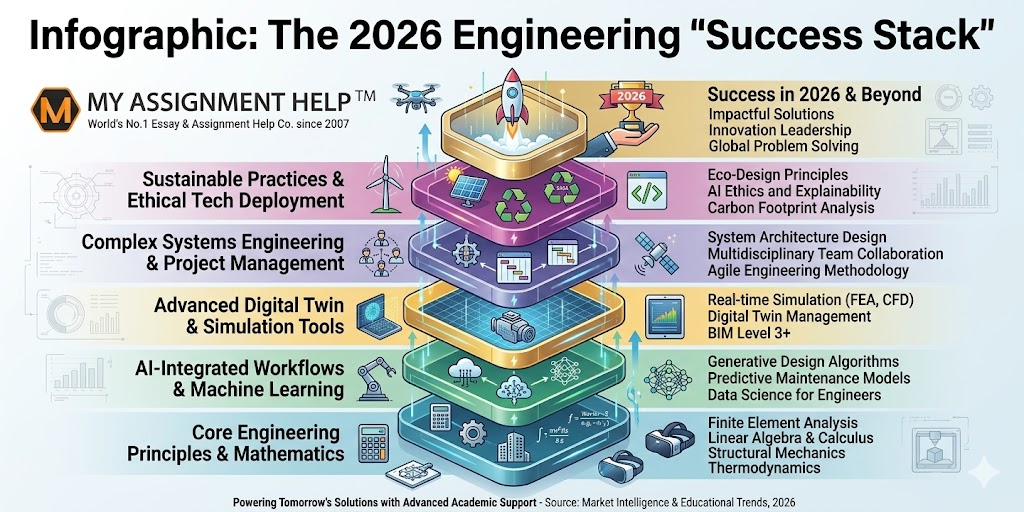
5. Cybersecurity for Physical Infrastructure
As infrastructure becomes more “connected,” it becomes more vulnerable. In 2026, a Civil Engineer working on a bridge or a Mechanical Engineer designing a municipal water system must understand the basics of cybersecurity.
Key Takeaways
- Hybridity is King: The most employable engineers in the US combine traditional physics/math with high-level data science.
- AI is a Tool, Not a Replacement: Mastery of generative engineering tools is the top differentiator for 2026 hires.
- Sustainability is Profitable: Understanding green standards is no longer optional; it is a core commercial requirement.
- Systems Thinking: The ability to see how a single component fits into a massive, connected “Digital Twin” is essential.
Author Bio
Dr. Sarah Mitchell is a Senior Academic Consultant and Content Strategist at MyAssignmentHelp. With over 12 years of experience in STEM education and professional career coaching, she specializes in helping US engineering students navigate the transition from classroom theory to high-tech industry application. Her work focuses on the ethical integration of AI in modern engineering curricula.
FAQ Section
Q: Which engineering major has the highest starting salary in 2026?
A: Currently, Computer Engineering and Petroleum Engineering (with a focus on carbon sequestration) lead the pack, often seeing starting offers between $85,000 and $110,000 in the US.
Q: Is MATLAB still relevant in 2026, or is Python taking over?
A: While Python is dominant for general data science and AI, MATLAB remains the gold standard in US aerospace and defense sectors for control system design and signal processing.
Q: How do I show “AI Literacy” on my resume?
A: Don’t just list “AI.” Mention specific projects where you used generative design tools or implemented machine learning algorithms to optimize a physical system.
